


Recent News
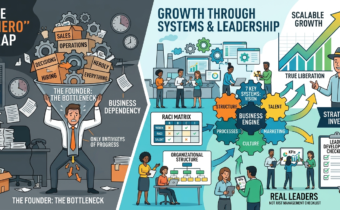
Build a Team That Elevates Your Business: The Systems and Principles to Scale Without Relying on You
Introduction This article highlights an uncomfortable but liberating truth: most businesses don’t grow because they depend excessively on the founder. The owner becomes the bottleneck, doing everything, deciding everything, and carrying the operational burden. It emphasizes that real growth comes when strong teams, replicable systems, and a distributed leadership culture are built. This article expands
Read More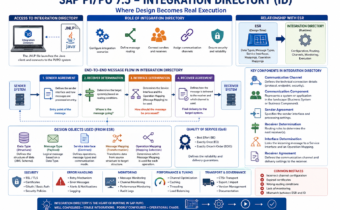
Integration Directory in SAP Process Orchestration: where design turns into real execution
The Integration Directory in SAP PI/PO 7.5 is the component responsible for configuring and managing the runtime execution of integrations. While the Enterprise Services Repository defines the design of integration objects, the Integration Directory determines how messages flow between systems, what routes they follow, and which transformations are applied. Traditionally accessed through a JNLP-based Java client, it allows configuration of key elements such as Communication Channels, Sender and Receiver Agreements, and routing and interface determination rules.
A message flow typically includes reception, destination determination, transformation via mappings, and final delivery to the target system. The Integration Directory consumes design objects from ESR, including Data Types, Message Types, Service Interfaces, Message Mappings, and Operation Mappings, to execute integration scenarios.
It also manages critical aspects such as security, quality of service (QoS), error handling, and monitoring. Proper configuration is essential to ensure system stability and performance. Although widely used in on-premise environments, the evolution toward SAP Integration Suite reflects a transition to modern cloud-based, API-driven, and event-oriented architectures.
Read More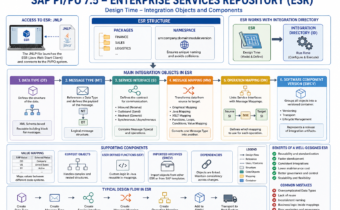
Enterprise Services Repository (ESR) in SAP Process Orchestration: designing integrations that scale (instead of collapsing)
The Enterprise Services Repository (ESR) in SAP PI/PO 7.5 is the central component for integration design, where data structures, service contracts, and transformations are modeled. Traditionally accessed through a JNLP-based Java client, ESR allows teams to define Data Types, Message Types, and Service Interfaces that form the foundation of communication between systems. Message Mappings transform data between formats, while Operation Mappings orchestrate which transformations are applied in each integration flow.
Software Component Versions (SWCV) provide structure and version control, enabling organized transport and lifecycle management of integration artifacts. Features like Value Mapping and User Defined Functions allow customization and flexibility in handling complex scenarios. Reusability is a critical success factor, reducing development effort and increasing consistency, while proper versioning ensures stability and backward compatibility.
The ESR works in conjunction with the Integration Directory, which manages runtime configuration and execution logic. Although still widely used, integration strategies are evolving toward cloud-based platforms like SAP Integration Suite, reflecting a shift toward modular, API-driven, and DevOps-enabled architectures. Understanding ESR remains essential for building robust, scalable integration landscapes.
Read More