

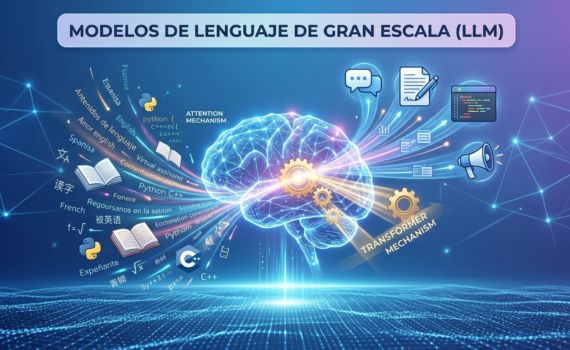
Introduction to Large Scale Language Models (LLM)
Category:Artificial Intelligence,Programming1. Introduction
Large-Scale Language Models (LLMs) have represented one of the most significant advances in the field of artificial intelligence (AI) in recent years. These models are primarily based on deep neural networks, which has given them the ability to understand, generate, and manipulate human language with unprecedented accuracy and versatility. From virtual assistants like ChatGpt, Grok, Gemini, and DeepSeek to code-generating tools like Claude, text-summarizing tools, and even creative storytelling tools, LLMs are transforming the way we interact with technology.
In this article, we will explore what LLMs are, how they work, their practical applications, limitations, and the impact they are having on society. We will break down the technical concepts in an accessible way, provide practical examples, and discuss the future of this technology. This article is designed to be clear, concise, and didactic, with a focus on helping readers understand both the fundamentals and implications of LLMs.
2. What is a Large-Scale Language Model?
An LLM is a type of artificial intelligence model designed to process and generate text in natural language. These models are trained on vast amounts of text data (often billions of words) to learn linguistic patterns, grammatical structures, facts, and, to some extent, reasoning. LLMs are typically deep neural networks based on architectures like Transformers, which allow them to capture complex relationships between words and phrases.
Example 1: How does an LLM answer a question? Imagine you ask an LLM: What is the capital of France? The model doesn’t consciously “know” the answer, but it has been trained on millions of documents that mention Paris as the capital of France. By processing your question, the model predicts the most likely answer: “The capital of France is Paris.”
Main characteristics of LLMs:
- Massive scale: Trained on enormous datasets (such as books, articles, websites, etc.).
- Generalization ability: They can perform multiple tasks, from answering questions to translating languages or writing poetry.
- Context: They are able to maintain context in long conversations or extensive texts.
- Text generation: They can produce coherent and relevant text, such as stories, essays, or code.
3. How do LLMs work?
To understand how LLMs work, it is important to break down their key components: architecture, training, and inference.
3.1 Architecture: The Power of Transformers
Most modern LLMs are based on an architecture called Transformers, introduced in the seminal 2017 article “Attention is All You Need” by Vaswani et al. Transformers are particularly efficient at modeling the relationships between words in a sequence, thanks to a mechanism known as attention.
The attention mechanism allows the model to focus on the most relevant parts of a sentence or text when processing it. For example, in the sentence “The cat on the roof is black,” the model can identify that “cat” and “black” are related, even if they are separated by other words.
Example 2: Attention Mechanism in Action
Suppose a Language Modeling (LM) is processing the sentence: Maria bought a book that John recommended. The attention mechanism will assign greater weight to the connections between “Maria,” “book,” and “John,” somewhat ignoring less relevant words like “that.” This allows the model to understand who bought what and who recommended it.
3.2 Training: Learning from the World
LMs are trained in two main phases:
- Pre-training: In this phase, the model is fed vast amounts of text (e.g., books, Wikipedia articles, social media posts) so that it can learn general linguistic patterns. This is done through tasks such as predicting the next word in a sentence (language modeling) or filling in missing words (masked language modeling).
- Fine-tuning: In this phase, the model is further trained for specific tasks, such as answering questions, translating languages, or generating code. This is done to improve its performance in those specific areas.
Example 3: Pre-training in action Imagine a Language Learning Model (LLM) being trained on the text: The sun shines in the sky. During pre-training, the model might be tasked with predicting the word “sky” given the context “The sun shines in the.” By processing millions of similar phrases, the model learns that “sky” is a likely word in this context.
3.3 Inference: Generating responses
Once trained, the LLM enters the inference phase, where it generates responses based on the inputs.user. During inference, the model predicts the probability of each word in a sequence and selects the most appropriate one, adjusting to the provided context.
Example 4: Text Generation
If you give the model the input: Write a poem about autumn, the LLM will generate a sequence of words that form a coherent poem, such as:
Golden leaves fall slowly and bright,
the wind whispers on cold nights,
autumn paints the world calmly,
a canvas of reds and melancholy.
This is achieved because the model has learned poetic patterns and associations between words like “autumn,” “leaves,” and “wind.”
4. Applications of LLMs
Given their increasing popularity, LLMs have been implemented in a wide variety of fields. Below, we explore some of the most common ones, with practical examples.
4.1 Virtual Assistants LLMs are the basis of assistants like Gemini, Grok, and ChatGpt. These assistants can answer questions, offer recommendations, and engage in natural conversations.
Example 5: Conversation with an Assistant
- User: How can I improve my productivity?
- LLM: You can try techniques like the Pomodoro Technique, where you work for 25 minutes and then take a 5-minute break. Prioritizing tasks with the Eisenhower Matrix, which divides tasks into urgent and important, is also helpful.
4.2 Content Generation LLMs can write articles, stories, scripts, and more. For example, this very article could have been entirely written by an LLM or formatted by one.
Example 6: Generating a Short Story
- Input: Write a short story about a lost astronaut.
- Output: Astronaut Elena floated in the vastness of space, her damaged spacecraft adrift. Through her visor, the stars seemed to whisper ancient secrets. With limited oxygen, he decided to send a final message to Earth, not one of despair, but of awe at the vastness of the cosmos…
4.3 Language Translation
LLMs can translate text between languages with high accuracy, often outperforming traditional translators.
Example 7: Translation
- Input (Spanish): El amor es un lenguaje universal.
- Output (English): Love is a universal language.
4.4 Code Generation
LLMs can write code in languages such as Python, JavaScript, or C++, making them valuable to developers.
Example 8: Code Generation
- Input: Write a Python function that calculates the factorial of a number.
- Output: def factorial(n):
if n == 0 or n == 1:
return 1
else:
return n * factorial(n – 1)
4.5 Education and Mentoring
LLMs can explain complex concepts in a simple way, answer academic questions, and provide examples. Example 9: Explaining a Concept
- User: Explain what relativity is.
- LLM: Relativity, proposed by Einstein, describes how time and space are interconnected. For example, a clock on a rocket traveling near the speed of light will tick more slowly than one on Earth, a phenomenon known as time dilation.
5. Limitaciones de los LLM
However, despite their constantly growing capabilities, LLMs face significant limitations that are crucial to understand when using them.
5.1 Falta de comprensión real
LLMs don’t “understand” the world like humans do; they simply predict patterns based on data. This can lead to incorrect or absurd answers in specific contexts.
Ejemplo 10: Error de un LLM
- Usuario: ¿Cuántos dientes tiene un elefante?
- LLM (respuesta errónea): Un elefante tiene 32 dientes.
Realidad: Los elefantes tienen solo 4-6 molares grandes en un momento dado, no 32 dientes como los humanos.
5.2 Sesgos en los datos
LLMs can perpetuate biases, especially those already present in the data used for training.
For example, if the training dataset contains gender stereotypes, the model could generate biased responses.
5.3 Costo computacional
Training and running LLM requires a huge amount of computational resources, making it expensive and with a significant environmental impact.
To truly understand why running an LLM is so expensive, we must differentiate between training (creating the model) and inference (using it to answer questions). While training requires months of massive computing power, inference presents a constant challenge in terms of scale and resources.
Here we break down the technical factors that increase the cost of computing:
5.3.1 Memory Consume VRAM
Unlike traditional software that resides on the disk or regular RAM, an LLM must be fully loaded into the VRAM (Video RAM) of the graphics cards (GPU) to respond quickly.
Software
- Parámeters and Precision: A model with 70 billion parameters (70B), if executed in 16-bit precision (FP16), requires at least 140 GB of VRAM just to exist in memory.
- Quantization: To reduce this cost, quantization techniques are used that compress the model to 4 or 8 bits, allowing it to fit on less expensive hardware, albeit with a slight loss of precision.
5.3.2 The Attention Mechanism and Quadratic Complexity
El corazón del Transformer, el mecanismo de Auto-atención, es computacionalmente “hambriento”.
- Complexity: Attention has a complexity of O(n2), where n is the length of the sequence (the context).
- Impact: If you double the length of the question or document that the model must read, the computational effort to process the relationships between words quadruples. This explains why models with very large “context windows” (such as 128k or 1M tokens) require massive infrastructures of interconnected GPU clusters..
5.3.3 Token Operations (Flops)
Each time the model generates a single word (a token), it must perform billions of mathematical operations (matrix additions and multiplications)..
- Sequential Generation: Unlike a Google search, which is nearly instantaneous, an LLM generates text word by word. For a 500-word response, the model must “go through” its billions of parameters 500 consecutive times.
- Memory Bandwidth: The bottleneck is usually not the chip’s calculation speed, but the speed at which data moves between the GPU’s memory and its processing core.
5.3.4 Infrastructure and Energy
Keeping these models available 24/7 involves enormous operating costs:
- Elite Hardware: Specialized chips such as the NVIDIA H100 or Blackwell are required, which cost more than $30,000 per unit.
- Electricity and Refrigeration: A single AI server rack can consume as much energy as several average homes. Furthermore, constant liquid or air cooling adds a significant extra cost.
Cost Resume: Inference vs. Training
| Factor | Training(Training) | Inference (Serving) |
|---|---|---|
| Duration | Months (only one) | Continued (per user) |
| Hardware | Thousands of GPUs synchronized | De 1 a 8 GPUs por instancia |
| Objetive | Adjust the net weights | Perform calculations with fixed weights |
| Main Cost | Energy and hardware depreciation | Bandwidth and latency |
5.4 Hallucinations
LLMs sometimes generate false but plausible information, a phenomenon known as “hallucination”.
Example 11: Hallucinatión
- Usuario: ¿Quién inventó el teléfono móvil?
- LLM (respuesta incorrecta): El teléfono móvil fue inventado por Alexander Graham Bell en 1973.
Realidad: Martin Cooper inventó el primer teléfono móvil en 1973.
This phenomenon in Large Scale Language Models (LLMs) is perhaps the most critical technical and ethical challenge facing generative AI today. We must consider that this is not a simple “software bug,” but rather an intrinsic characteristic of how these models are designed.
Next, we explore why they occur, what types exist, and how attempts are being made to mitigate them.
5.4.1 ¿Why an LLM Hallucinate?
To understand the phenomenon of hallucination, we must remember that an LLM is not a database or an encyclopedia; rather, it is a statistical token prediction engine..
- Probability vs. Truth: The model chooses the next word based on its likelihood of appearing after the previous one, according to its training data. If the statistically most likely path is false, the model will follow it without hesitation.
- Lack of a “World Model”: Since LLMs lack a physical or logical understanding of the real world, they don’t “know” that Alexander Graham Bell couldn’t have invented the cell phone in 1973 because they don’t understand the timeline as an absolute concept, but rather as a relationship of words.
- Data Compression: During training, models must compress petabytes of information into a few gigabytes of parameters. During this “loss” process, specific details (dates, exact names, figures) often become blurred, creating false or mixed memories.
5.4.2 Types of Hallucinations
We can then classify hallucinations into two main categories:
- Intrinsic Hallucinations: In these cases, the model directly contradicts the information provided in the prompt.
- Example: You give it a text that says “The net profit was 5 million” and the model summarizes by saying “The company lost 5 million”.
- Extrinsic Hallucinations: The model generates information that is out of context and factually false in the real world.
- Example: Inventing a bibliographic citation from a famous author who never existed or creating a code function that uses a non-existent library.
5.4.3 Factors that increase the risk
- Temperature (Creativity): When configuring the model, a high “temperature” setting will force the model to choose less likely words to be more creative, thus increasing the probability of hallucinating.
- Confirmation bias (Sycophancy): The model will sometimes try to please the user. If you state something false in the question (“Why is the sun green?”), the model might “go along with you” and justify it.
- Noisy training data: If the model read fake news or forums with errors during its training, it will replicate those errors as truths.
5.4.4 Mitigation Strategies: How do we solve it?
The industry is using several layers of security to “ground” the model:
- RAG (Retrieval-Augmented Generation): It is the most effective technique. Instead of relying solely on the model’s “memory,” it allows you to search reliable external documents before responding.
- RLHF (Reinforcement Learning from Human Feedback): Human trainers correct the model when it hallucinates, teaching it that “I don’t know” is also a valid answer and is preferable to a lie.
- Verification Chains (CoVe): In this case, the model is asked to first generate an answer, then verify its own facts, and finally correct the original answer.
Technical Reflection:Ironically, the ability to “hallucinate” is what makes LLMs brilliant at poetry, brainstorming, and fiction. The challenge for modern engineering is to maintain creativity for artistic tasks and eliminate hallucination for precision work.
6. Ethics and social challenges
The use of LLM raises important ethical questions:
- Privacity: The data used to train LLM may contain sensitive information.
- Desinformation: The ability to generate convincing text can be used to create fake news.
- Access: High-quality LLMs are often controlled by large corporations, raising concerns about equity and access.
Example 12: Ethics in content creation
An LLM could be used to create a fabricated article that appears credible, such as: Scientists discover that chocolate cures cancer. This highlights the importance of verifying sources and using LLMs responsibly.
7. Future of LLM
The LLM field is evolving rapidly. Some future trends include:
- More efficient models: Researchers are developing LLMs that require fewer computational resources.
- Multimodal Integration: LLMs are starting to combine text with images, audio, and other data.
- Greater personalization: LLMs of the future could be better adapted to the individual needs of users.
Example 13: LLM multimodal Imagine an LLM that not only answers questions but also generates an image based on your description or analyzes a photo you upload. For example, you could say: Describe a beach at sunset and create an image, and the model would generate both the text and an illustration.
8. Conclusion
Large-Scale Language Models (LLMs) are a powerful tool that is redefining how we interact with technology. From answering questions to generating creative content or assisting with complex tasks, LLMs have enormous potential, but they also come with ethical and technical challenges. As this technology advances, it is crucial to use it responsibly and understand its limitations.
In this article, we have explored the fundamentals of LLMs, their operation, applications, limitations, and their impact on society. With practical examples, we hope to have provided a clear and instructive overview of this fascinating area of artificial intelligence.
9. References
- Vaswani, A., et al. (2017). “Attention is All You Need.” Advances in Neural Information Processing Systems.
- Brown, T., et al. (2020). “Language Models are Few-Shot Learners.” arXiv preprint arXiv:2005.14165.
- Sitios web de xAI y otras fuentes confiables sobre IA.