Category Archives: Business Management

  • 0

Build a Team That Elevates Your Business: The Systems and Principles to Scale Without Relying on You

Category:Business Management Tags : 

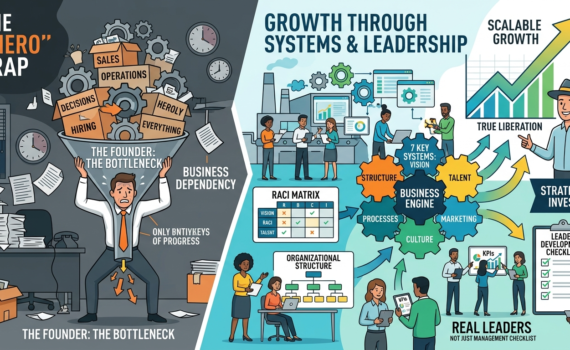
Introduction This article highlights an uncomfortable but liberating truth: most businesses don’t grow because they depend excessively on the founder. The owner becomes the bottleneck, doing everything, deciding everything, and carrying the operational burden.

It emphasizes that real growth comes when strong teams, replicable systems, and a distributed leadership culture are built. This article expands on that vision with depth, practical frameworks, operational checklists, and concrete strategies.

1. The “One Hero” Trap: Why Your Business Isn’t Growing

Many entrepreneurs fall into the trap of being indispensable. They work longer hours, control every detail, and end up enslaved by their own creation. Signs you’re in this trap:

  • You’re the only one closing major sales.
  • Strategic decisions stall if you’re not present.
  • The team expects constant instructions.
  • You bill well, but you don’t enjoy the money or have free time.

Moving from operator to leader requires a change in mindset: stop doing and start designing systems.

2. The 7 Fundamental Systems of Business Growth

A methodology has been developed based on 7 key systems:

  1. Vision and Strategy System — Total team alignment with clear objectives.
  2. Organizational Structure System — Defined roles, functional organizational chart.
  3. Talent and Leadership System — Attracting, developing, and retaining leaders.
  4. Process and Operations System — Documentation and standardization.
  5. Financial and Metrics System — Control of numbers and profitability.
  6. Marketing and Sales System — Predictable customer flow.
  7. Culture and Ownership System — Sense of belonging and shared responsibility.

Each system is broken down with key indicators, tools, and examples.

3. How to Develop Real Leaders (Not Just with a Title)

“Many want the title, but not the power.” Developing leaders takes time, sound judgment, and sustained accountability.

Checklist for Developing Leaders on Your Team:

  1. Identify candidates with potential (attitude + results).
  2. Assign projects with real responsibility and accountability.
  3. Provide weekly mentoring (one-on-one).
  4. Teach data-driven decision-making.
  5. Allow for controlled mistakes as learning experiences.
  6. Measure not only results, but also the ability to replicate.
  7. Celebrate visible leadership publicly.
  8. Create a clear path for growth and compensation.

4. Organizational Structures that Scale

Recommended designs by stage:

  • Initial stage (up to 10 people): Flat and agile.
  • Growth (10-50): Departmentalization.
  • Scale (>50): Matrix or process-based.

Checklist for Designing Structure:

  • Map current processes.
  • Define clear responsibilities (RACI matrix).
  • Eliminate overlaps.
  • Create job descriptions.
  • Establish KPIs for each role.
  • Review every 6 months.

5. Effective Delegation: From Micromanagement to Trust Practical

steps for delegating:

  • Select the appropriate task.
  • Define expected results and standards.
  • Grant real authority.
  • Establish review points.
  • Give constructive feedback.
  • Recognize success.

6. Culture of Ownership and Sense of Belonging

Connect with previous topics: the team must benefit from growth. Combine systems with financial models (profit sharing, variable bonuses, etc.).

7. Common Mistakes That Hinder Growth

  • Hiring too quickly and firing too slowly.
  • Lack of process documentation.
  • Failing to measure what matters.
  • Resistance to change.
  • Lack of investment in training.

8. Practical 90-Day Roadmap for Implementing Systems

Month 1: Diagnosis + Vision + Structure.

Month 2: Processes + Talent.

Month 3: Metrics + Culture + Adjustments.

Includes detailed weekly checklists, templates, and success metrics.

9. Case Studies and Practical Examples

Analysis of companies that applied these principles.

10. The Founder’s Role in the New Stage:

From Maker → Strategist → Investor. How to prepare the company for sale or massive scaling.

Conclusion

The central message is clear: your business can grow much more when you stop being the center of attention and make your team the driving force. By applying the systems, checklists, and principles presented, any entrepreneur can break the cycle of dependency, develop leaders, and build a company that endures.


  • 0

Is it really impossible? Challenging the limits of the conceivable

Category:Artificial Intelligence,Business Management,Programming Tags : 

Stating that something is impossible may sound categorical, but in reality, it hides a much more complex truth. What is considered impossible today could be a tangible reality tomorrow. The history of humanity is littered with examples that corroborate this: from the dream of flight to the conquest of space, time and again we have challenged the limitations of our knowledge and technology to achieve what was previously considered improbable.

The Development of Knowledge and Technology: Scientific and technological advances are fundamental drivers of progress. As we expand our knowledge of the universe and develop new tools, the possibilities expand exponentially. What was unthinkable yesterday becomes an everyday reality today.

Examples That Defy the Impossible:

  • Flying: In the past, the idea of ​​flying was considered a mythological fantasy. However, the invention of the airplane and the development of aviation completely transformed the way we travel.
  • Instant Communication: Long-distance communication was an unattainable dream until the invention of the telephone, radio, and the internet. Today, we can hold real-time conversations with people anywhere in the world.
  • Traveling to space: The conquest of space is an extraordinary achievement that has challenged our understanding of the universe. What was once a science fiction dream has become a tangible reality thanks to the development of rockets and space technology.

The importance of attitude and perseverance:

Claiming that something is impossible can be a mental barrier that limits our ability to innovate and progress. It is essential to maintain an open and receptive attitude to new ideas, no matter how far-fetched they may seem. Perseverance and determination are also key to overcoming obstacles and turning the impossible into the possible.

Conclusion:

Claiming that something is impossible is an act of presumption that ignores the potential of human ingenuity and scientific development. History teaches us that the limits of the possible are infinitely expandable. The key to achieving what is considered impossible today lies in the constant pursuit of knowledge, technological innovation, and an open and persevering attitude.

Remember:

  • The development of knowledge and technology expands the possibilities of what can be achieved.
  • History is full of examples that challenged the impossible and made it a reality.
  • Attitude and perseverance are key to overcoming obstacles and achieving the improbable.
  • Saying something is impossible limits the potential of human ingenuity and progress.

Dare to challenge the impossible. The future is full of possibilities waiting to be discovered.


  • 0

Building Trust, Not Walls: Why Remote Work Thrives on Authenticity

Category:Business Management

The traditional office environment is evolving. Gone are the days when presenteeism (being physically present) equated to productivity. A new era of remote and hybrid work models is upon us, and for a successful transition, companies need to prioritize trust over proximity.

Trust: The Cornerstone of Remote Work

Let’s face it, forcing employees into a physical space doesn’t guarantee commitment or results. In today’s landscape, building an organizational culture based on trust is paramount. This means empowering employees, fostering open communication, and holding everyone accountable for results, regardless of location.

Here’s how:

  • Transparency is key: Share company goals, challenges, and successes openly. This fosters a sense of shared purpose and eliminates the feeling of being out-of-the-loop for remote teams.
  • Embrace open communication: Encourage regular check-ins, team meetings (both virtual and in-person if desired), and open communication channels. This allows for clear expectations, timely feedback, and a collaborative spirit.
  • Empowerment over micromanagement: Trust your employees to manage their time effectively and deliver results. Micromanagement breeds resentment and stifles creativity. Focus on outcomes, not office hours.

Redefining the Workplace: A Team, Not a Family

The idea of the workplace as a family is outdated. While fostering a sense of camaraderie is important, it’s crucial to remember that a company is a team working towards a shared goal.

This approach acknowledges that:

  • Goals, not relationships, drive success: The focus should be on achieving company objectives, not replicating family dynamics in the office.
  • Talent is fungible: In today’s competitive job market, top talent has options. Companies need to create an environment that fosters growth and motivates employees, while acknowledging that people move on in their careers.

Building a Culture of Trust: The Competitive Advantage

By prioritizing trust and focusing on results, companies unlock the true potential of remote and hybrid work models. This fosters a culture of:

  • Increased productivity: Employees who feel trusted and empowered are more likely to go the extra mile.
  • Improved morale: A focus on results over presenteeism creates a happier and more engaged workforce.
  • Enhanced talent acquisition: A strong remote work culture attracts top talent, regardless of location.

In conclusion, the future of work is not defined by physical presence, but by the strength of an organization’s culture. By prioritizing trust, open communication, and results-oriented thinking, companies can unlock the true potential of their workforce and thrive in the remote work era.


  • 0

Why the Hybrid Hustle Won’t Last: Remote Work is the Future of Company Culture

Category:Business Management

The recent trend of hybrid work models, with employees splitting time between office and home, has been touted as a compromise between the full return to the office and complete remoteness. However, this approach might be missing the mark altogether. There’s a growing argument that remote work, not a hybrid solution, is the true path forward for building strong company cultures and fostering trust between employees and employers.

The Hybrid Disconnect:

The hybrid model can create a sense of disparity among employees. Those who primarily work remotely might feel ostracized or out of the loop, hindering collaboration and communication. This can breed resentment and chip away at the very foundation of a positive culture.

Trust, Not Walls:

The shift back to office environments can be seen as a sign of companies not trusting their employees to be productive remotely. This can be a major demotivator, especially for those who have thrived in a work-from-home setting. Remote work, when implemented effectively, demonstrates trust and empowers employees to manage their time effectively.

Beyond the Four Walls:

The idea that company culture requires physical proximity is outdated. Remote teams can build strong bonds through effective communication tools and a focus on shared goals. In fact, a remote environment can open up a wider talent pool, fostering a more diverse and inclusive culture.

The Future is Flexible:

The most successful companies of tomorrow will embrace flexibility. Remote work allows employees to achieve a better work-life balance, leading to increased satisfaction and productivity. This, in turn, fosters a culture of ownership and accountability, as employees take a more invested approach to their work.

Building a Remote Culture:

Of course, remote work requires intentionality. Companies need to invest in clear communication channels, collaborative tools, and opportunities for virtual team building. Leaders need to be skilled in remote management, fostering a sense of community even when employees are geographically dispersed.

The hybrid model might seem like a safe middle ground, but it risks creating a fractured culture and a disengaged workforce. By embracing remote work fully, companies can create a future where trust, flexibility, and a strong sense of community are the hallmarks of a thriving organization.


  • 0

Key Performance Indicators (KPIs): Steering Your Business by the Numbers

Category:Business Management

n the world of business, data is king. But with so much information at your fingertips, it can be overwhelming to know what truly matters. This is where Key Performance Indicators (KPIs) come in. KPIs are like your business’s compass, guiding you towards your strategic goals.

What are KPIs?

KPIs are quantifiable measurements that track your progress towards specific objectives. They tell you how well your business is performing in key areas. Unlike general metrics, KPIs focus on the most critical aspects that directly impact your success.

Defining Your KPIs

The first step is to identify your overall business goals. Are you aiming to increase sales, improve customer satisfaction, or boost brand awareness? Once you have your goals in mind, translate them into specific, measurable objectives. Here’s a helpful framework:

  • Specific: Clearly define what you want to achieve. Instead of “improve customer service,” aim for “reduce customer wait time by 20%.”
  • Measurable: KPIs should be quantifiable. Use numbers and data points to track progress.
  • Attainable: Set realistic targets that motivate your team.
  • Relevant: KPIs should directly tie back to your overall goals.
  • Time-bound: Establish a timeframe for achieving your KPI targets.

Measuring Your KPIs

Once you’ve defined your KPIs, you need a system to track and measure them. There are various methods for this:

  • Data collection tools: Many CRM, marketing automation, and sales software platforms offer built-in KPI tracking features.
  • Spreadsheets: Simple spreadsheets can be effective for basic KPI tracking.
  • Dashboards: Visual dashboards provide a clear at-a-glance overview of your KPI performance.

The Power of KPIs

Effective KPI use offers a multitude of benefits:

  • Improved Decision-Making: Data-driven insights from KPIs help you make informed decisions about resource allocation and strategy adjustments.
  • Enhanced Team Alignment: When everyone focuses on the same KPIs, teams work cohesively towards shared goals.
  • Performance Monitoring: KPIs allow you to continuously monitor progress and identify areas that need improvement.
  • Increased Accountability: Defined targets set clear expectations and create a culture of accountability within your organization.

By implementing a strategic KPI framework, you can steer your business towards success. Remember, KPIs are not set in stone. Regularly review and adjust them as your business evolves and goals change. With clear and measurable KPIs guiding the way, your organization can navigate the ever-changing business landscape with confidence.


  • 1

Competitive Intelligence and its impact on financial planning

Category:Business Management Tags : 

Introduction

In a business world characterized by uncertainty, globalization, and rapid technological evolution, organizations face the constant challenge of remaining competitive and relevant. Competitive intelligence (CI) emerges as a key strategic tool that allows companies not only to survive but to thrive in dynamic environments. This process, which involves collecting and analyzing information about products, customers, and competitors, is not limited to a specific area of the organization but adopts a systemic approach encompassing all levels and departments. By enabling companies to “perceive” and interact with their environment, CI becomes a means to identify opportunities, mitigate risks, and generate differentiators that position the organization in less competitive markets, known as “blue oceans.” This article delves into the definition, benefits, methodologies, and challenges of competitive intelligence, emphasizing its role in strategic planning and value creation for shareholders and employees.

1. What is Competitive Intelligence?

Competitive intelligence can be defined as a structured and ethical process of collecting, analyzing, and applying relevant information about an organization’s environment. This information includes data on competitors, customers, market trends, technological innovations, and other external factors that impact business performance. Unlike industrial espionage, which involves illegal or unethical practices, CI relies on legitimate, open sources such as market reports, academic publications, public data, social media, and competitor analysis.

The primary goal of CI is to provide actionable information to executives, facilitating strategic decision-making. For instance, a company can use CI to identify market gaps, anticipate competitors’ moves, or assess the feasibility of new products. This approach not only enhances the organization’s responsiveness but also fosters innovation by enabling the creation of differentiating strategies.

2. Competitive Intelligence in Strategic Planning

Strategic planning is a comprehensive process that defines an organization’s direction in the short, medium, and long term. This process cannot be confined to a single department, as it requires a holistic vision that integrates all aspects of the company, from production to marketing, finance, and human resources. Competitive intelligence plays a crucial role in this context by providing the data foundation needed to align strategies with environmental dynamics.

For example, a company using CI can identify emerging trends in consumer behavior, allowing it to adjust marketing campaigns or develop products that meet specific needs. Similarly, by analyzing competitors, the organization can detect weaknesses in their strategy or areas where it can differentiate itself. This systemic approach ensures that strategic decisions are grounded in concrete facts, reducing uncertainty and improving the effectiveness of initiatives.

3. Creating Blue Oceans through Competitive Intelligence

The concept of “blue oceans,” developed by W. Chan Kim and Renée Mauborgne, refers to the creation of new market spaces where competition is irrelevant. Competitive intelligence is an essential tool for identifying and exploiting these blue oceans, as it enables organizations to discover opportunities unexplored by competitors. For example, a company analyzing consumer preferences can identify underserved market niches and develop innovative products or services to address them.

A classic example of a blue ocean is Cirque du Soleil, which combined elements of traditional circus with theater to create a unique experience that attracted a new customer segment. CI can facilitate such innovations by providing insights into unmet market needs and competitors’ limitations. By doing so, companies can position themselves as leaders in emerging markets, achieving sustainable growth and reducing competitive pressure.

4. Quantitative and Qualitative Impact of Competitive Intelligence

While modern administrative practices often prioritize quantitative metrics, such as return on investment (ROI) or revenue growth, competitive intelligence requires a more balanced approach that considers both quantitative and qualitative outcomes. For instance, a company can measure the impact of a CI-based strategy in terms of increased market share or cost reduction, but it should also assess its effect on customer satisfaction, employee morale, and brand perception.

A quantitative analysis might include metrics like sales growth following the launch of a product informed by CI data, while a qualitative analysis could evaluate how the company has improved its positioning relative to competitors. This comprehensive approach ensures that CI not only delivers financial benefits but also contributes to overall organizational development.

5. Ethics in Competitive Intelligence

One of the greatest challenges of competitive intelligence is ensuring the process is conducted ethically. The line between legitimate information collection and espionage is thin, and organizations must establish clear policies to avoid practices that could harm their reputation or violate regulations. For example, using public sources such as financial reports, market databases, and social media posts is entirely valid, whereas unauthorized access to competitors’ confidential information is illegal and unethical.

To ensure ethics in CI, companies should train their teams in best practices and establish codes of conduct that promote transparency and accountability. Additionally, collaborating with specialized CI consultants can help organizations implement robust processes that respect legal and ethical boundaries.

6. Implementing a Competitive Intelligence Process

Implementing a competitive intelligence process requires a structured methodology encompassing the following stages:

  1. Defining Objectives: Identify the key questions the organization needs to answer, such as “What are our competitors doing?” or “What are the emerging market trends?”
  2. Data Collection: Use legitimate sources, such as market reports, public databases, customer surveys, and social media analysis, to gather relevant information.
  3. Data Analysis: Process the collected information to identify patterns, trends, and opportunities. Tools like SWOT analysis, Porter’s Five Forces, and PESTEL analysis are useful in this stage.
  4. Decision-Making: Translate findings into actionable strategies, such as launching a new product, entering an international market, or optimizing a marketing campaign.
  5. Continuous Monitoring: Establish a monitoring system to evaluate the impact of implemented strategies and adjust them as needed.

7. Benefits of Competitive Intelligence

Competitive intelligence offers a wide range of benefits for organizations, including:

  • Informed Decision-Making: Provides reliable data that reduces uncertainty in strategic planning.
  • Competitive Differentiation: Enables companies to identify opportunities for innovation and stand out in the market.
  • Anticipation of Changes: Helps organizations foresee trends and competitors’ moves, allowing them to adapt quickly.
  • Sustainable Growth: Facilitates expansion into new markets and improves customer relationships.
  • Organizational Development: Promotes a work environment that fosters innovation and employee growth.

8. Challenges of Competitive Intelligence

Despite its benefits, competitive intelligence also presents significant challenges. These include:

  • Information Overload: The vast amount of available data can make it difficult to identify relevant information.
  • Resource Constraints: Small and medium-sized enterprises may lack the resources needed to implement a robust CI process.
  • Resistance to Change: Some organizations may be reluctant to adopt a data-driven approach, preferring to rely on intuition.
  • Ethical Risks: The temptation to resort to unethical practices can damage the company’s reputation.

To overcome these challenges, organizations must invest in technological tools, train their teams, and foster a culture of continuous learning.

9. The Role of Technology in Competitive Intelligence

Technology plays an increasingly important role in competitive intelligence. Tools such as big data analytics, artificial intelligence, and machine learning enable companies to process large volumes of information efficiently and extract valuable insights. For example, social media monitoring platforms can track mentions of a brand or its competitors in real-time, while AI algorithms can predict market trends based on historical data.

Additionally, data visualization tools facilitate the communication of findings to executives, enabling faster decision-making. However, technology must be complemented by human judgment to ensure that insights are relevant and applicable to the organization’s context.

10. Conclusion

Competitive intelligence is much more than a data collection process; it is a strategic tool that enables organizations to navigate complex environments and generate sustainable value. By adopting a systemic and ethical approach, companies can use CI to identify opportunities, innovate, and differentiate themselves in the market. In a world where competition is increasingly intense, competitive intelligence becomes a key differentiator that empowers organizations to achieve their strategic goals, foster employee growth, and create value for shareholders. Effective CI implementation requires commitment, resources, and a long-term vision, but the benefits it offers fully justify the investment.


  • 0

Attitude and Attention to Detail: Key Elements in a Selection Process

Category:Business Management Tags : 

Introduction

In the professional world, there’s a saying that holds a profound truth: “Experience is gained, and knowledge is acquired, but attitude, attention to detail, and the desire to do things well are qualities that aren’t found everywhere and should carry more weight in a selection process.”

This statement highlights that while technical skills and experience are important, intangible qualities make the difference between a good professional and an exceptional one. In an increasingly competitive job market, companies aren’t just looking for candidates with impressive resumes—they also seek individuals with the right mindset to face challenges, learn, and contribute positively to the team.

This article explores why attitude, attention to detail, and passion for quality work should be decisive factors in hiring, sometimes even outweighing experience and technical knowledge.


1. Experience is Gained, Knowledge is Acquired

1.1. Experience as a Relative Factor

Work experience is a common requirement in many job postings, but does it truly guarantee a candidate’s success in a role?

  • Learning curve: A less experienced person with strong adaptability can quickly outperform someone with years in the field but little flexibility.
  • Diverse contexts: Experience in one company doesn’t always translate directly to another, as each organization has its own dynamics and culture.

1.2. Knowledge Can Be Developed

Technical skills can be taught, but the willingness to learn isn’t always present.

  • Training capacity: An employee with a positive attitude and eagerness to grow will absorb knowledge faster than an unmotivated but experienced one.
  • Constant evolution: In a world where technologies and methodologies change rapidly, what matters isn’t just what someone already knows but their ability to keep learning.

2. Attitude: A Non-Negotiable Factor

2.1. What Defines a Good Work Attitude?

Attitude encompasses multiple aspects that directly influence performance and workplace culture:

  • Proactiveness: Taking initiative to solve problems without waiting for instructions.
  • Resilience: Handling challenges without losing motivation.
  • Teamwork: Willingness to collaborate and support colleagues.
  • Adaptability: Flexibility to adjust to changes and new challenges.

2.2. Why Should Attitude Matter More?

  • Impact on workplace culture: A positive employee boosts team morale and productivity.
  • Lower turnover: Committed and motivated employees tend to stay longer.
  • Greater innovation: Those passionate about their work often bring fresh ideas and creative solutions.

3. The Details That Make a Difference

3.1. The Importance of Small Gestures

What often sets an outstanding professional apart isn’t major achievements but their attention to detail:

  • Punctuality and organization: Being on time, meeting deadlines, and staying organized reflect responsibility.
  • Effective communication: Active listening, constructive feedback, and clear expression improve coordination.
  • Presentation care: From well-written emails to flawless reports, details convey professionalism.

3.2. Details Recruiters Should Observe

Beyond the resume, these qualities can be identified through:

  • Group dynamics: Observing how the candidate interacts with others.
  • Situational questions: Assessing problem-solving under pressure.
  • Post-interview follow-up: A thank-you email or courteous attitude can be telling.

4. The Drive to Do Things Well: The Engine of Success

4.1. Passion vs. Obligation

An employee who works out of passion performs very differently from one who just clocks in:

  • Work quality: Those who enjoy their work strive to exceed expectations.
  • Long-term commitment: Passion reduces absenteeism and increases loyalty.

4.2. How to Identify a Passionate Candidate?

  • Body language: Enthusiasm when discussing past projects.
  • Deep questions: Genuine interest in the role and company.
  • Track record of growth: Candidates who have proactively advanced in past roles.

5. How to Prioritize Attitude Over Experience in Hiring

5.1. Rethinking Job Requirements

  • Focus on soft skills: Include traits like “teamwork” or “growth mindset” in job postings.
  • Practical assessments: Test abilities rather than just years of experience.

5.2. Behavioral Interviews

Questions like:

  • “Tell me about a time you had to learn something new quickly.”
  • “Describe a situation where you overcame a challenge as a team.”

5.3. Probation Periods Focusing on Adaptability

Give opportunities to less experienced but high-potential candidates, evaluating their integration and value-add.


Conclusion

While experience and knowledge matter, attitude, attention to detail, and the drive to excel are what truly determine a professional’s success in an organization. Companies that prioritize these in hiring don’t just recruit competent employees—they bring in committed, innovative individuals who drive sustainable growth.

In a world where technical skills can be taught, but passion and character are innate, it’s worth asking: Are we choosing the right candidates, or just those who look right on paper?

Next time you review a resume, remember: “You can teach an employee to use software, but you can’t teach them to want to do it well.”


  • 0

The Death of the Traditional 9-to-5: Why Flexible Work Journeys Are the Future

Category:Business Management

The modern workforce is undergoing a seismic shift. The conventional 9-to-5 workday, once the cornerstone of professional life, is rapidly becoming obsolete. As technology continues to blur the lines between work and personal life, employees are demanding greater flexibility and autonomy. The fixed working journey, with its rigid schedules and outdated expectations, is giving way to a more fluid, goal-oriented approach.

The Limitations of Traditional Work Schedules

The traditional 9-to-5 workday was born out of the Industrial Revolution, when factories and manufacturing drove economic growth. However, this model has failed to adapt to the changing needs of the modern workforce.

  1. Inefficient Use of Time: Standardized work schedules often result in periods of low productivity, as employees struggle to maintain focus throughout the day.
  2. Lack of Work-Life Balance: Rigid schedules make it challenging for employees to balance personal responsibilities, leading to burnout and decreased job satisfaction.
  3. Talent Waste: Traditional schedules overlook individual differences in productivity, creativity, and energy levels, wasting valuable talent.
  4. Inability to Adapt: Fixed schedules hinder organizations’ ability to respond to changing market conditions, customer needs, and technological advancements.

The Rise of Goal-Oriented Work

Goal-oriented work, also known as Results-Oriented Work Environment (ROWE), focuses on achieving specific objectives rather than adhering to a fixed schedule.

  1. Autonomy and Flexibility: Employees have the freedom to manage their time, prioritizing tasks and minimizing distractions.
  2. Increased Productivity: By focusing on outcomes, employees can optimize their work processes, leading to enhanced productivity.
  3. Improved Work-Life Balance: Goal-oriented work allows employees to integrate personal and professional responsibilities seamlessly.
  4. Talent Optimization: This approach acknowledges individual differences, enabling employees to work when and how they are most effective.

Benefits for Employers

Adopting a goal-oriented approach offers numerous benefits for organizations:

  1. Enhanced Innovation: Flexible work arrangements foster creativity, encouraging employees to explore new solutions.
  2. Increased Employee Engagement: Autonomy and trust boost job satisfaction, reducing turnover rates.
  3. Better Work-Life Balance: Improved employee well-being leads to reduced absenteeism and increased productivity.
  4. Competitive Advantage: Embracing flexible work arrangements attracts top talent and enhances organizational reputation.

Challenges and Solutions

Implementing goal-oriented work requires addressing several challenges:

  1. Managerial Mindset Shift: Managers must focus on outcomes rather than hours worked.
  2. Communication and Collaboration: Regular check-ins and transparent feedback ensure seamless teamwork.
  3. Performance Metrics: Develop metrics focused on objectives, quality, and timeliness.
  4. Technology and Tools: Utilize platforms that facilitate flexible work, such as project management software and virtual communication tools.

Real-World Examples

Companies like:

  1. Amazon: Offers flexible scheduling and 30-hour workweeks.
  2. Microsoft: Implemented a four-day workweek in Japan, resulting in increased productivity.
  3. Dell: Adopted flexible work arrangements, enhancing employee satisfaction and productivity.

The Future of Work

As technology continues to advance and the workforce evolves, the traditional 9-to-5 will become increasingly obsolete.

  1. Artificial Intelligence and Automation: AI-driven tools will optimize work processes, freeing humans for creative, high-value tasks.
  2. Remote Work: Virtual collaboration will become the norm, blurring geographical boundaries.
  3. Lifelong Learning: Continuous skill development will be essential for professionals to remain relevant.
  4. Wellness and Self-Care: Employee well-being will become a top priority, driving organizational success.

Conclusion

The fixed working journey is a relic of the past. Goal-oriented work, with its emphasis on autonomy, flexibility, and outcomes, is the future. By embracing this shift, organizations can:

  1. Unlock Talent Potential: Foster creativity, innovation, and productivity.
  2. Enhance Employee Well-being: Promote work-life balance, job satisfaction, and reduced burnout.
  3. Drive Business Success: Stay competitive, adapt to changing markets, and achieve strategic objectives.

As we navigate this transformative landscape, one thing is clear: the traditional 9-to-5 workday is no longer the only – or best – way to work.


  • 0

The Hierarchical Structure of Companies: Understanding the Feudal Legacy and Its Disadvantages

Category:Business Management

The modern corporate world is often compared to a feudal system, where power is concentrated at the top and trickles down through layers of management. This hierarchical structure has been the cornerstone of organizational design for centuries, with CEOs and executives wielding significant influence over decision-making processes. However, this traditional model has several disadvantages that can stifle innovation, hinder employee growth, and ultimately harm the company’s overall performance.

Origins of Hierarchical Structure

The hierarchical structure of companies has its roots in ancient civilizations, where monarchies and feudal systems dominated social and economic landscapes. The industrial revolution further solidified this structure, as factories and mass production required strict control and efficiency. As corporations grew, the hierarchical model became entrenched, with clear lines of authority and decision-making processes.

Disadvantages of Hierarchical Structure

  1. Stifled Innovation: Hierarchical structures often discourage creativity and innovation. Employees at lower levels may hesitate to suggest new ideas, fearing rejection or retribution from superiors. This creates a culture of conformity, where groundbreaking concepts are suppressed.
  2. Limited Employee Growth: Hierarchical structures restrict career advancement opportunities, as employees must wait for superiors to vacate positions or retire. This leads to frustration, turnover, and talent loss.
  3. Inefficient Decision-Making: Decision-making processes are often slow and bureaucratic, with multiple layers of approval required. This delays responses to market changes, competitor actions, or customer needs.
  4. Lack of Transparency: Hierarchical structures can foster secrecy and opacity, making it difficult for employees to access information or understand company-wide goals.
  5. Disengaged Workforce: Employees at lower levels may feel disconnected from company objectives, leading to disengagement and decreased motivation.
  6. Resistance to Change: Hierarchical structures can resist adaptation to changing market conditions, technologies, or customer needs.
  7. Inequitable Distribution of Power: Hierarchical structures concentrate power in the hands of a few, often leading to abuses of authority and unequal treatment of employees.

Alternatives to Hierarchical Structure

  1. Flat Organizational Structures: Companies like Valve Corporation and GitHub have adopted flat structures, eliminating middle management layers and empowering employees to make decisions.
  2. Holacracy: This management system distributes authority and decision-making among teams, rather than relying on traditional hierarchies.
  3. Self-Management: Companies like Morning Star and The Wikimedia Foundation have implemented self-management models, where employees take ownership of their work and make decisions autonomously.

Implementing Change

Transitioning from a hierarchical structure requires:

  1. Leadership Commitment: CEOs and executives must champion change and foster a culture of openness and collaboration.
  2. Employee Empowerment: Give employees autonomy to make decisions and take ownership of their work.
  3. Cross-Functional Teams: Encourage collaboration across departments to break down silos.
  4. Transparent Communication: Foster open communication channels and provide regular feedback.
  5. Performance Metrics: Develop metrics that reward innovation, collaboration, and employee growth.

Conclusion

The hierarchical structure of companies, inherited from feudal regimes, poses significant disadvantages in today’s fast-paced business environment. By recognizing these limitations and exploring alternative models, organizations can unlock innovation, foster employee growth, and achieve sustainable success. Embracing change requires leadership commitment, employee empowerment, and a willingness to disrupt traditional power structures. Only then can companies adapt, thrive, and remain relevant in an ever-evolving marketplace.


  • 0

Safeguarding Creativity: An In-Depth Look at SafeCreative

Category:Business Management,Programming Tags : 

Introduction:

In the dynamic digital landscape, protecting intellectual property has become more crucial than ever. With the rise of online content creation and sharing, individuals and organizations alike need robust tools to safeguard their creative works. SafeCreative emerges as a reliable and innovative platform designed to address these challenges, offering creators a secure and efficient way to manage and protect their intellectual property.

What is SafeCreative?

SafeCreative is a leading global copyright registry that provides creators with a comprehensive suite of tools to protect their intellectual property rights. Launched in 2007, this platform has become a go-to solution for individuals, artists, writers, musicians, and other content creators who seek to assert control over their creative works in the digital age.

Key Features of SafeCreative:

  1. Copyright Registration: SafeCreative offers a user-friendly copyright registration process that allows creators to register their works quickly and efficiently. By registering their creations on the platform, users establish a public record of their ownership, making it easier to enforce their rights in case of infringement.
  2. Blockchain Technology: Leveraging blockchain technology, SafeCreative ensures a secure and tamper-proof record of copyright registrations. Blockchain’s decentralized and transparent nature enhances the integrity of the copyright registration process, providing creators with an extra layer of trust and security.
  3. Digital Timestamping: SafeCreative provides digital timestamping for creative works, offering an immutable record of when a specific piece of content was created or registered. This feature is particularly valuable in legal disputes, helping creators establish the timeline of their work.
  4. Creative Commons Integration: SafeCreative supports Creative Commons licenses, allowing creators to choose from a range of licensing options that suit their preferences. This flexibility empowers creators to define how others can use, share, and build upon their work, fostering a collaborative and open creative environment.
  5. Global Recognition: SafeCreative provides international copyright protection, recognized in over 173 countries. This global reach ensures that creators can assert their rights on a broad scale, irrespective of geographic boundaries.

Benefits of Using SafeCreative:

  1. Protection Against Infringement: By registering creative works on SafeCreative, creators deter potential infringers and have a solid foundation for legal action in case of unauthorized use.
  2. Establishing Ownership: The platform’s copyright registration and blockchain technology help creators establish a clear and irrefutable record of ownership, facilitating easier enforcement of intellectual property rights.
  3. Streamlined Licensing: SafeCreative simplifies the licensing process, allowing creators to choose the level of access they grant to others. This flexibility fosters collaboration while preserving the creator’s rights.
  4. Global Reach: SafeCreative’s recognition in numerous countries ensures that creators enjoy international protection, providing peace of mind for those seeking to share their works globally.

Conclusion:

In an era where digital content is prolific and easily accessible, protecting creative works is a paramount concern. SafeCreative emerges as a powerful ally for creators, offering a comprehensive and user-friendly platform to register, protect, and manage intellectual property. With features such as blockchain technology, digital timestamping, and global recognition, SafeCreative stands at the forefront of the battle to secure the rights of creators in the ever-evolving landscape of the digital age. By embracing such innovative solutions, creators can confidently share their work with the world, knowing that their intellectual property is in safe hands.


Archives

Categories