

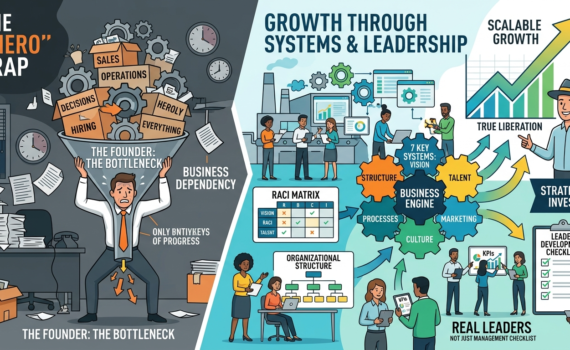
Build a Team That Elevates Your Business: The Systems and Principles to Scale Without Relying on You
Category:Business ManagementIntroduction This article highlights an uncomfortable but liberating truth: most businesses don’t grow because they depend excessively on the founder. The owner becomes the bottleneck, doing everything, deciding everything, and carrying the operational burden.
It emphasizes that real growth comes when strong teams, replicable systems, and a distributed leadership culture are built. This article expands on that vision with depth, practical frameworks, operational checklists, and concrete strategies.
1. The “One Hero” Trap: Why Your Business Isn’t Growing
Many entrepreneurs fall into the trap of being indispensable. They work longer hours, control every detail, and end up enslaved by their own creation. Signs you’re in this trap:
- You’re the only one closing major sales.
- Strategic decisions stall if you’re not present.
- The team expects constant instructions.
- You bill well, but you don’t enjoy the money or have free time.
Moving from operator to leader requires a change in mindset: stop doing and start designing systems.
2. The 7 Fundamental Systems of Business Growth
A methodology has been developed based on 7 key systems:
- Vision and Strategy System — Total team alignment with clear objectives.
- Organizational Structure System — Defined roles, functional organizational chart.
- Talent and Leadership System — Attracting, developing, and retaining leaders.
- Process and Operations System — Documentation and standardization.
- Financial and Metrics System — Control of numbers and profitability.
- Marketing and Sales System — Predictable customer flow.
- Culture and Ownership System — Sense of belonging and shared responsibility.
Each system is broken down with key indicators, tools, and examples.
3. How to Develop Real Leaders (Not Just with a Title)
“Many want the title, but not the power.” Developing leaders takes time, sound judgment, and sustained accountability.
Checklist for Developing Leaders on Your Team:
- Identify candidates with potential (attitude + results).
- Assign projects with real responsibility and accountability.
- Provide weekly mentoring (one-on-one).
- Teach data-driven decision-making.
- Allow for controlled mistakes as learning experiences.
- Measure not only results, but also the ability to replicate.
- Celebrate visible leadership publicly.
- Create a clear path for growth and compensation.
4. Organizational Structures that Scale
Recommended designs by stage:
- Initial stage (up to 10 people): Flat and agile.
- Growth (10-50): Departmentalization.
- Scale (>50): Matrix or process-based.
Checklist for Designing Structure:
- Map current processes.
- Define clear responsibilities (RACI matrix).
- Eliminate overlaps.
- Create job descriptions.
- Establish KPIs for each role.
- Review every 6 months.
5. Effective Delegation: From Micromanagement to Trust Practical
steps for delegating:
- Select the appropriate task.
- Define expected results and standards.
- Grant real authority.
- Establish review points.
- Give constructive feedback.
- Recognize success.
6. Culture of Ownership and Sense of Belonging
Connect with previous topics: the team must benefit from growth. Combine systems with financial models (profit sharing, variable bonuses, etc.).
7. Common Mistakes That Hinder Growth
- Hiring too quickly and firing too slowly.
- Lack of process documentation.
- Failing to measure what matters.
- Resistance to change.
- Lack of investment in training.
8. Practical 90-Day Roadmap for Implementing Systems
Month 1: Diagnosis + Vision + Structure.
Month 2: Processes + Talent.
Month 3: Metrics + Culture + Adjustments.
Includes detailed weekly checklists, templates, and success metrics.
9. Case Studies and Practical Examples
Analysis of companies that applied these principles.
10. The Founder’s Role in the New Stage:
From Maker → Strategist → Investor. How to prepare the company for sale or massive scaling.
Conclusion
The central message is clear: your business can grow much more when you stop being the center of attention and make your team the driving force. By applying the systems, checklists, and principles presented, any entrepreneur can break the cycle of dependency, develop leaders, and build a company that endures.