

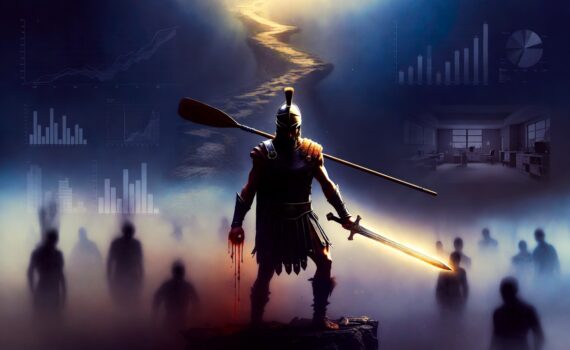
Why Every Leader Must Descend into the Underworld: Lessons from Odysseus for Business (and Life)In Book XI of the Odyssey,
Category:Business ManagementHomer does not narrate an epic battle or a clever escape. He narrates a ritual. A man digs a pit with his sword, pours libations of milk, honey, sweet wine, and water, sprinkles white flour, and slaughters black animals. The blood runs steaming into the ground, and from the mist, the dead rise. Odysseus, the hero who survived Troy, the Cyclops, and the sorceress, feels true fear for the first time — fear that leaves him pale. He has not come to conquer. He has come to ask.
This episode, known as the Nekyia, is more than ancient literature. Joseph Campbell saw it as a universal map of the hero’s journey. Carl Jung called it nekyia: the descent of consciousness into its own depths. In the world of business, this descent is not optional. It is inevitable. Every successful company and every leader with real experience eventually reaches a point where the road home — to sustainability, renewed purpose, or genuine growth — passes directly through the underworld.
The Context of Descent: When Past Success Is No Longer Enough
Imagine Odysseus after a year on Circe’s island. He has survived the impossible, but to return to Ithaca he must fulfill a condition that sounds like a cruel joke: he must consult the prophet Tiresias in the realm of the dead. His heart breaks; he sits down and weeps, momentarily wishing he no longer had to live.
This moment repeats constantly in business. A startup celebrates closing its Series A with euphoria. A family business reaches its best year ever. An executive climbs the ladder to become CEO. Then modern Circe appears: a saturated market, technological disruption, an internal crisis, or personal burnout. The mentor, coach, or investor says: “Before you continue, you must face what you’ve been avoiding.”
The descent is not sinking. It is descending with purpose. The difference is crucial, and Homer illustrates it perfectly through two characters: Elpenor and Odysseus.
Elpenor, the youngest crewman — “neither very brave nor very wise” — gets drunk, sleeps on the roof, falls, and breaks his neck. No one buries him. His shade is the first to appear before Odysseus, begging for a proper funeral and for his oar to be planted on his grave. He represents accidental failure, unclosed opportunities, abandoned projects without closure. In business, these are emotional debts to teams, lost customers without feedback, postponed ethical decisions, or failed products that were never properly analyzed in a postmortem.
Odysseus, by contrast, descends consciously. He follows the ritual to the letter. He controls his fear with structure. This is the first business principle of the Nekyia: a structured descent turns panic into direction.
The Five Steps of the Ritual: A Framework for Business Crises
Homer details a protocol that any leader can adapt:
- Reach the edge: Recognize that the known world ends here. In business, this means accepting that previous strategies no longer work. Many leaders resist and prolong the pain.
- Dig the pit: Create a sacred, bounded space for the encounter. In practice: a strategic offsite retreat, a deep failure analysis, a cultural audit, or an honest retrospection session without distractions.
- Pour the libations: Offer value first (milk, honey, wine, water, flour). Before asking the market, employees, or investors for answers, give value: transparency, recognition, investment in training, or simply active listening.
- Slaughter the black animals and guard the blood: Confront the darkness with sacrifice. This means making painful cost cuts, letting go of beloved but toxic people, abandoning failing product lines, or publicly acknowledging strategic mistakes.
- Maintain control with the sword: Odysseus does not let everyone drink the blood. He controls the flow of information. In a crisis, not every voice carries equal weight. Prioritize data, experts, and key stakeholders.
This ritual transforms a reactive crisis into an intentional process.
Revelations from the Underworld: What Only the “Dead” Will Tell You
Tiresias and the Bitter but Useful Prophecy
Tiresias drinks the blood and reveals the truth: return is possible, but it will be difficult. Poseidon is angry. There will be temptations (the cattle of the Sun) that must not be touched. If respected, they will arrive late, battered, and alone. Then the real work at home begins.
In business, this is the prophecy every founder eventually receives: growth will not be linear. There will be regulations, aggressive competitors, cash crises, or generational shifts. The key is not avoiding suffering but navigating it with discipline. The warning about the sacred cattle equates to not chasing vanity metrics, not burning cash on irresponsible marketing, and not compromising core values for rapid growth.
The Oar as a Symbol of Redefined Purpose
The most powerful image is the oar. Tiresias instructs Odysseus to carry an oar inland until he meets people who have never seen the sea and mistake it for a winnowing fan. There he must plant the oar and make a sacrifice to Poseidon. Only then can he die in peace.
This is one of the deepest messages for leaders: your primary tool (the oar = your core expertise, flagship product, or business model) must be taken into completely new contexts. The founder of a software company must “plant the oar” in traditional industries. The traditional manufacturer must digitize until its “oar” becomes unrecognizable to its original audience. True business maturity occurs when you turn your greatest strength into something that serves people who don’t even know they need it.
The Mother and the Emotional Cost
Anticlea, Odysseus’s mother, reveals she died of longing for him. “It was not illness, my son. It was missing you.” Three times Odysseus tries to embrace her; three times she dissolves like a shadow.
In the corporate world, this encounter represents the family and personal cost of leadership. Many executives discover too late that their ambition “killed” key relationships. The descent forces one to confront this void. Companies that ignore the well-being of their leaders and teams pay the price in turnover, burnout, and talent loss.
Achilles and the Great Lie of Glory
The most devastating moment is the encounter with Achilles. Odysseus congratulates him on reigning among the dead. Achilles replies that he would rather be the lowliest laborer on earth serving a poor farmer than reign over all the dead.
The warrior who chose short, glorious life admits he made the wrong deal. This line dismantles the toxic “hustle culture” and “24/7 grind” narrative. In 2026, amid record burnout rates among founders and executives, the message is clear: no achievement justifies sacrificing your life. Post-mortem glory (successful IPO, unicorn valuation, media recognition) tastes like ashes if you have lost your health, relationships, or sense of purpose.
Practical Applications: Implementing the Nekyia in Your Company
1. Underworld Audit (Quarterly or Annually)
Gather your leadership team for a ritual offsite. Mandatory questions:
- What have we left unburied (zombie projects, unkept promises)?
- Which sacred cows are we tempted to slaughter?
- Where do we need to carry our oar inland?
2. Speaking with Internal “Dead”
Use the Jungian shadow in business: interview former employees, churned customers, and ex-partners. The blood (real attention and fair compensation for feedback) makes them speak with brutal honesty.
3. Post-Descent Leadership
Odysseus returns wiser but changed. The best CEOs after deep crises lead with greater humility, sharper strategic clarity, and better work-life balance. Modern examples abound: leaders who survived bankruptcies, scandals, or personal collapses and emerged with more resilient companies.
4. Organizational Culture That Allows Descent
The healthiest companies create “safe spaces to go down.” Sabbatical programs, psychological check-ins, budgets for resilience training, and internal narratives that normalize failure as part of the heroic journey.
Conclusion: Returning with the Oar on Your Shoulder
Odysseus’s descent is not the end of the story. It is the turning point. Afterward come the final trials, the slaying of the suitors, and a peaceful old age. None of that would have been possible without going down.
In today’s volatile, uncertain, complex, and ambiguous (VUCA) business world, leaders who avoid the underworld eventually sink. Those who descend intentionally emerge with a recalibrated internal compass, a more mature strategy, and a deeper understanding of what truly matters.
Your company is sailing toward the edge of the known world. The wind is pushing you. The question is not whether you will descend, but how: like Elpenor — accidentally and without ritual — or like Odysseus — with sword in hand, clear questions, and the willingness to hear uncomfortable truths?
Dig the pit. Pour the libations. Speak with your dead. Plant your oar where no one expects it.
Only then can you truly return home — not as the same person who left, but as the leader your market, your team, and you yourself truly need.