There are plenty resources on this topic, but this post based on my experience intend to allow SAP Customers that are still using SAP PI as the top integration solution in their landscape, to allow to secure their integration scenaries between an SAP system like CRM (Customer Relationship Management), ERP (Enterprise Resource Planning), SOLMAN (Solution Manager) between antohers and the IBM MQ system.
Goal
The goal of this post is to allow you to setup a TLS connection between an an IBM MQ system version 7.5 or upper and a SAP PI system running over Netweaver(NW) 7.4 or upper using a communication channel type JMS versión 1.x or 2.x.
Assumptions
The JMS drivers are already deployed at the Netweaver System.
The JVM is already updated to the last version available.
The Netweaver components are already updated to the last version available.
Steps
1. Oracle usually is the provider of the Java Virtual Machine (JVM) used at Operating System level where the Netweaver is installed, since MQ System use the IBM JVM, this could create the issue “2393 MQRC_SSL_INITIALIZATION_ERROR / MQRC_UNSUPPORTED_CIPHER” once the channel wll be started. In order to prevent that Cipher Suite Mapping should be disable, this will be achieved following steps described at Note 2218025.
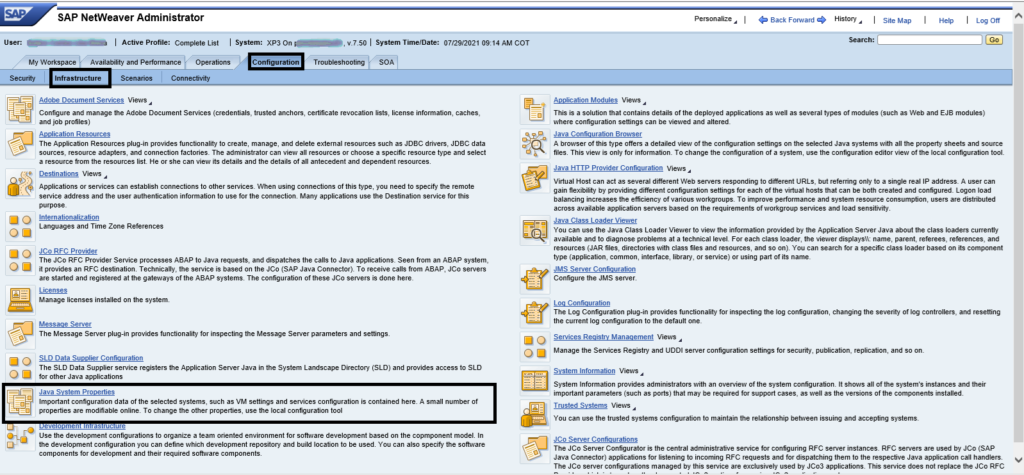
1.1. Please logon to the NWA and once there, please locate the Configuration Tab -> infrastructure -> Java System Properties
Step 1.1 Configuration Tab -> infrastructure -> Java System Properties
1.2. Once there, the node Z* should be selected and navigate to the tab System VM Parameters, there add the following parameter.
com.ibm.mq.cfg.useIBMCipherMappings=false
Step 1.2 Node-> System VM Parameters
2. Adjust the allowed security protocols that could be used to stablish a handshake at the system; in order to do this must follow the same steps defined at point 1.1, once there add the following parameter:
jdk.tls.client.protocols = TLSv1,TLSv1.1,TLSv1.2
Be aware that this is just an illustrative example.
3. In order to prevent the issue “error connecting due to missing class com.ibm.mq.jms.MQQueueConenctionFactory“, the SAP Note 1751177 should be applied, this will allow to preload the related classes of MQ Driver
3.1 Please login into NWA and go through this path Java System Properties → Applications, once there please be aware to select the property com.sap.aii.adapter.jms.app application and modify the property value.
MQ 7.50
Set the “preloadClasses” property as: com.ibm.mq.MQEnvironment,com.ibm.mq.internal.MQCommonServices,com.ibm.mq.jms.MQQueueConnectionFactory,com.ibm.mq.jms.MQTopicConnectionFactory.
Step 3.1 Java System Properties → Applications->com.sap.aii.adapter.jms.app application
4. Once this activities will be finished, ask to your Basis team to make a full restart of the application.
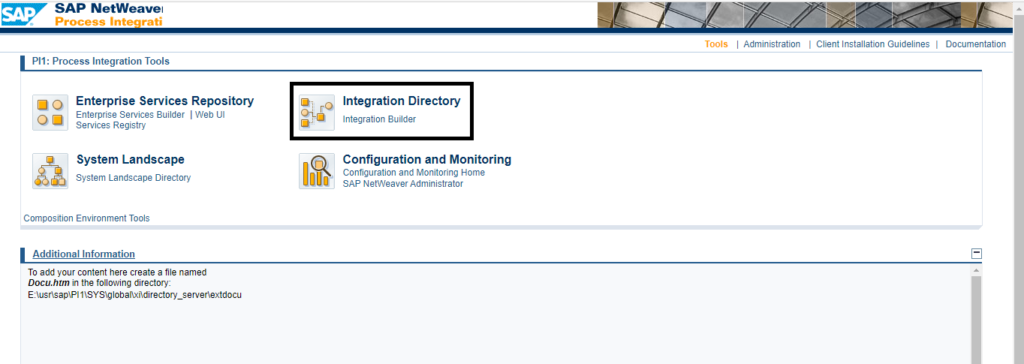
5. Create or Modify the communication channel using the integration builder tool or through NWDS
Be aware to create the communication Channel at the Integration directory as JMS 1.X under NW 7.4 or 2.x under NW7.5
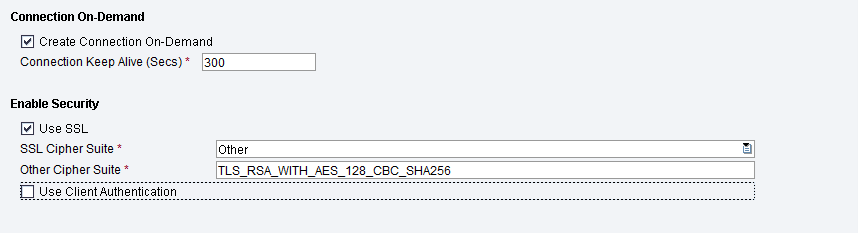
Then at the option Enable Security, mark useSSL and select OTHER in the SSL Cipher Suite dropdown, next be aware to write the ciphersuite that will be used in the other cipher suite text field.
Conclusion
In summary, securing our internal connections will allow us to protect the data, our most valuable assets inside the companies and this post will help you to enable secure connections from your NW PI/PO systems to external servers.
I hope this article was valuable and i appreciate your feedback, comments or suggestions, please feel ree to reache out me if you have any further question
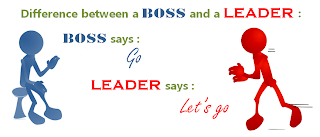
Leadership and Comprehensive Quality Management are two fundamental concepts in today’s world, however, authors who dare to present theses on both concepts tend to confuse the term related to leadership with the fact of being a boss, so they do not It must be strange to find that authors like Douglas McGregor present it as a one-dimensional concept with two extremes, a fact that is clearly completely different from reality, especially if we consider that leadership completely transcends the act of giving instructions and indicating how to carry out a task. action, on the contrary, leadership invites action through example, for a better illustration of this topic I bring up an anecdote that was presented at a conference given by Mr. Miguel Ángel Cornejo in Mexico City in a prestigious company and if well the director of the same who was in charge of making the contacts could simply have gone home that night and said letting his employees take over the workshop, he did the opposite and as an attentive student he was in the front row to carry out the knowledge construction process, taking careful note of his interlocutor’s observations, a fact that had a similar effect on his employees ; Going back to Mcgregor and his two opposite positions, which he calls “X” and “Y”, we can see that the fundamental objective of this definition is to pigeonhole the leader within one of the two profiles he proposes, completely ignoring the elements that lead to a certain behavior. Now, if together with this fact we rely on the definitions presented by Professor Wilchez, we find a leadership figure defined around organizational hierarchies and bureaucratic patterns, which although they play an important role in decision making , are related to the “power” factor and to the decision-making processes within organizations, but they are insufficient to define a leader.
Although it is true that within organizations, as can be seen in the slides, the bureaucratic factor is decisive in the first instances to develop a first approximation of key elements within a strategic planning process, such as the preparation of the vision and the establishment of the elements that will serve as pillars for its future organic growth, it is also undeniable that later it will be necessary to involve all the agents participating in the process in any transformation activity that is carried out and in such virtue It is highly probable that change managers begin to stand out within the process, not only because of their commitment to it, but also because with their own example and service orientation, they generate commitment from their colleagues; However, the current paradigms that govern our society and that have marked the development of theories during the past centuries have tended, as previously mentioned, to blur the existing line between boss and leader, clearly generating a serious conflict. within any activity that implies the task of coordination since automatically, almost instinctively, the coordinator of the activity tends to be called the “leader”, just because he is delegated a position that has power and authority , which immediately translates into a latent threat that can lead to the failure of the activity undertaken. Under the previous premises we can appreciate how there is then a very fine line between leader and boss, which as previously mentioned tends to cross in an almost blatant way, however it is also common for economic portals such as CNN Expansión to present key elements that must be consider an individual to be a leader and not a boss, although it is true these factors will depend exclusively on the author’s ability to describe them and even to sell them to the reader, since there are abilities that are purely subjective and will depend to a large extent on the abilities of the person to interact effectively with their environment, it is for this reason that I will refer to the second milestone that is considered at the beginning of this essay, that is, the Integral Quality Management, an element that must be inherent to all the processes and activities that the human being develops effectively, however due to the constant development of paradigms , naturalness has been lost and has led us to pigeonhole ourselves in models that instead of evolving and transforming over time so that they can adjust to the new conditions that the environment presents, resist doing so, remaining stuck to the old practices and models that served in the past, then condemning activities that would have promising futures to a gradual extinction, however it is not strange that even in the midst of adversities there can be successful cases that produce amazing results, let us note, for example, the current socio-reality Colombia’s economy, although it is far from being the dream, is an example of how daring to break the old paradigms generate radical transformations that modify the perception of reality and although it may sound crazy, I would dare to say that this is the product of management management that has been given to some of the most important issues on the national agenda. If we then consider the case of Comprehensive Quality Management, we can see that it arises more as a consequence of a strategic planning process, which seeks to establish characteristics that significantly improve business competitiveness, however I discern this fact, since They should be a natural part of the DNA of any public or private organization from its very inception, this essentially because it facilitates the effective control of the resources that participate in the development of the activity in order to potentiate the achievement of the established objective and this in turn it is the essence of leadership; It is not strange then that the confusion between the role of boss and leader occurs, however, when a leader does his job in an optimal way, no one will notice it since success will be considered a collective achievement of the entire team, in both when a boss reaches his goal everyone will know it because he himself is in charge of letting them know. If you have had the opportunity to read and enjoy a book on leadership, change management, breaking paradigms and profound transformations in the business environment, you will find a prominent and famous author for having written the book “Who Has Taken My Cheese”, in which considers how individuals face the challenges that society puts them, daring to leave their own comfort zone and exploring their environment looking for an effective way.
It activates adjusting to the challenges that it presents, it is true, we do not have control over our environment but we do have control over how we react to it, in order to take advantage of the opportunities it generates; Starting from this approach, we can see how elements are developed that must be considered by managers of the 21st century and those to come in order to potentiate the effective development of organizations and their collaborators, seeking to establish work cells that potentiate individual characteristics to achieve goals. the objectives by finding balances between the contributions that are made for the proposed achievement. This is why an effective manager must break the greatest paradigm that exists in the world, feel above others just for being called a “manager”, what you must remember is that you are in charge of people who are much more competent than he in the development of specific activities and that his main motivation is to focus the energies of all in the achievement of the desired goal.
At some point we have heard the phrase Process Reengineering, and just at that moment we have asked ourselves what is the objective of carrying out a reengineering and it is very likely that we have made the same mistake, assuming in a simplistic way that it is basically taking a process and adjust it in order to optimize its management of the resources it has at its disposal; However, over time and with different approaches, I have realized that this definition is quite far from the reality that the environment presents us with.
In the strict sense of the word, it could be defined that reengineering implies taking the inputs and outputs of the process as it is being executed, ignoring how it is done and focusing on what it is desired to obtain as a result, this then allows to reconstruct in a way The structure of the process is radically different, since the past is completely forgotten and a different strategy is built, normally this is always supported by the rule of 80 – 20, in order to achieve optimizations superior to those obtained if it were simply taken the current process and will adjust.
Originally published at http://gds-logic.blogspot.com/2013/09/que-es-reingenieria.html